

From Insights to Impact: The Experience Performance System (EPS) Playbook for Proving CX ROI
Why NPS-based ROI fails, and how modern CX leaders engineer business performance through friction, action, and behavioral economics.
From Insights to Impact: Why CX Is Stuck and What It Will Take to Break Free
Every CX leader knows this moment.
You walk into the executive meeting with your deck dialed in.
The data is clean.
The dashboards are sharp.
The verbatims are emotional.
The story is tight.
You show rising NPS. Improving CSAT. Declining complaint volume.
You walk them through journey friction. You highlight operational gaps.
You explain how customers feel and why it matters.
And then it happens.
The CFO leans forward and asks the question that quietly kills a thousand CX programs every year:
“So what?”
Not what did customers say.
Not what did we learn.
Not what does the dashboard show.
What did this change in the business?
Revenue.
Cost.
Risk.
Growth.
Silence.
Not because you don’t care.
Not because you didn’t work hard.
Not because the data isn’t real.
But because most CX organizations were never designed to answer that question in the first place.
This is the CX ROI crisis.
And it’s why so many CX leaders feel like they’re running faster every year, collecting more feedback, building better dashboards, writing tighter executive summaries, yet somehow losing influence instead of gaining it.
The Great CX Paradox
Here’s the uncomfortable truth:
CX has never been more visible and never been more strategically irrelevant.
Organizations now collect:
Millions of survey responses
Billions of experience signals
Endless streams of qualitative feedback
Behavioral data across every digital and physical touchpoint
Yet when budget season arrives, CX still fights for relevance.
Still struggles to defend headcount.
Still gets positioned as important, but not essential.
The paradox isn’t that CX lacks value.
It’s that CX operates inside a system that cannot translate experience into business performance.
Most CX teams are trapped inside what looks like a modern operating model, AI-powered dashboards, predictive analytics, text mining, sentiment engines, but is actually just a faster version of a 20-year-old approach:
Collect. Analyze. Report. Hope.
Hope leaders care.
Hope someone acts.
Hope impact shows up downstream.
But hope is not a business strategy.
The Fatal Disconnect: Sentiment vs. Economics
CX still runs on sentiment-first logic.
Executives run companies using economic-first logic.
And that mismatch is exactly why CX ROI narratives collapse the moment they hit the CFO’s desk.
Sentiment answers:
How do customers feel?
Executives need:
How did this change behavior and what did that do to the P&L?
This is the root of CX’s credibility problem.
The industry keeps trying to reverse-engineer financial impact from sentiment.
We take NPS.
We apply statistical gymnastics.
We build regression models.
We create ROI stories that look impressive… right up until they’re challenged.
And when they are, they collapse.
Because correlation can’t survive inside a boardroom.
Only causation can.
Why CX Feels Stuck, Even When It’s Working
This is the part most CX leaders won’t say out loud:
Deep down, we know our ROI stories feel fragile.
They rely on:
Lagging indicators
Proxy metrics
Loose assumptions
Correlation models that crumble under financial scrutiny
They sound good in internal meetings.
They fall apart in executive ones.
Which is why CX so often gets positioned as:
A reporting function
A listening post
A feedback engine
A culture team
A service organization
Important.
Valuable.
Nice to have.
But rarely, if ever, a business performance engine.
And until CX can show how it systematically turns customer friction into financial outcomes, this won’t change.
Not because executives don’t care about customers.
But because they’re accountable for growth, cost, and risk, not sentiment.
The Real Problem No One Wants to Admit
CX doesn’t have a measurement problem.
It has an operating model problem.
Traditional CX systems were built to manage insights.
They were never designed to engineer outcomes.
They can tell you:
Where customers struggle
What journeys underperform
Which moments create frustration
How sentiment is trending
But they cannot reliably answer:
What action did we take?
What behavior changed?
What financial impact did it create?
And that single gap is why CX still fights for credibility, funding, and strategic power.
The Shift That Changes Everything
Modern CX leadership requires a fundamentally different model.
Not a better dashboard.
Not smarter analytics.
Not prettier reports.
A performance system.
One designed to:
Detect friction
Prioritize what matters economically
Drive cross-functional execution
Measure behavioral change
Translate outcomes into P&L language
This is the Experience Performance System (EPS).
And it represents the shift from:
Understanding experience → Engineering business performance
Because the future of CX will not be won by who listens better.
It will be won by who acts faster, executes smarter, and proves impact in economic terms.
Why NPS-Based ROI Models Fail
Correlation Isn’t Causation And CFOs Know the Difference
At some point, every CX leader is taught the same ritual.
Take NPS.
Run a regression.
Correlate it to revenue, retention, or spend.
Calculate what “one point of NPS is worth.”
Then walk into the executive meeting armed with a clean-looking ROI model and hope no one pulls too hard on the thread.
This approach has become so standard that most CX teams don’t even question it anymore.
But here’s the uncomfortable truth:
The question itself is wrong.
“What is one point of NPS worth?”
It sounds smart.
It feels analytical.
It looks sophisticated.
It is none of those things.
Because financial impact does not come from sentiment.
It comes from behavior.
The Correlation Trap
Most NPS-based ROI models rely on correlation.
We analyze historical data.
We find relationships between NPS and outcomes.
We build regression models.
We assign economic value.
The logic goes something like this:
“When NPS rises, revenue rises. Therefore, improving NPS causes revenue growth.”
But correlation does not establish causation.
It only establishes coincidence.
Ice cream sales and drowning deaths rise together too, not because ice cream causes drowning, but because both increase in summer.
Executives understand this instinctively.
That’s why CFOs don’t trust CX ROI models built on correlation logic.
Because when budgets tighten and scrutiny increases, probability stories collapse.
Finance demands certainty.
Not statistical inference.
Not directional assumptions.
Not proxy logic.
Causation.
Why Sentiment Can’t Carry Financial Weight
NPS, CSAT, OSAT, CES - these are sentiment indicators.
They measure:
Emotion
Perception
Attitude
Memory
They do not directly measure:
Purchase behavior
Cost drivers
Retention mechanics
Revenue velocity
That doesn’t make them useless.
It makes them incomplete.
Sentiment can explain why customers behave the way they do.
But it cannot, by itself, prove how business outcomes were created.
And this is where CX ROI narratives break.
Because most models attempt to leap directly from:
How customers feel → Financial impact
Skipping the most critical layer:
Behavioral change
Executives don’t fund feelings.
They fund outcomes.
The CFO’s Silent Question
When CX leaders present NPS-based ROI models, CFOs are rarely confrontational.
They nod.
They listen.
They say “interesting.”
They move on.
But behind the silence is a simple calculation:
“If this ROI were real, we’d already be funding it aggressively.”
CFOs understand something the CX industry often avoids:
Financial attribution requires direct behavioral causation.
Not:
“Customers are happier.”
“Perception improved.”
“Sentiment trended upward.”
But:
Customers called less
Customers canceled less
Customers returned less
Customers repurchased faster
Customers spent more
Those are behaviors.
And behaviors create financial outcomes.
The Fragility Problem
Every CX leader feels it.
The fragility of ROI stories built on:
Proxy metrics
Soft assumptions
Multi-variable regression
Lagging sentiment indicators
They look strong in decks.
They sound smart in presentations.
They fall apart in financial reviews.
Which is why CX leaders instinctively avoid deep CFO scrutiny.
Because once finance starts asking:
How exactly did this change customer behavior?
What control groups were used?
How did you isolate causality?
Where is the finance validation?
Most ROI models crumble.
Not because CX failed.
But because the operating model never gave CX the tools to win that conversation.
The Industry’s Original Sin: Reverse-Engineering Impact
The CX industry made one critical mistake early:
It tried to reverse-engineer business value from sentiment.
Instead of designing CX as a system that creates financial outcomes by design.
So we built:
Surveys
Dashboards
Text analytics
Sentiment engines
Then asked:
“How do we prove ROI from this?”
But ROI cannot be retrofitted.
It must be architected.
This is why CX has spent two decades stuck in measurement debates instead of building execution systems.
We tried to make insight sound like impact.
But insight alone never creates value.
Action does.
The Hard Truth
CX does not need better ROI models.
It needs a new performance architecture.
One built around:
Friction identification
Execution velocity
Behavioral tracking
Financial attribution
Because the only defensible CX ROI story is one that follows this chain:
Friction → Action → Behavior → P&L
Not:
Sentiment → Assumption → Correlation → Hope
This is the shift that separates CX as reporting from CX as business performance engineering.
And it’s why the future of CX will belong to leaders who stop trying to prove ROI, and start designing systems that generate it.
The Experience Performance Reframe
From Insight Management to Business Execution
Every broken system eventually reaches a moment where incremental improvement no longer works.
You can’t optimize your way out of a flawed foundation.
That is exactly where CX is today.
For twenty years, the industry has focused on doing the same things better:
Better surveys
Better dashboards
Better analytics
Better reporting
Better storytelling
And yet, despite all that innovation, CX still struggles to produce consistent, defensible business impact.
Not because CX leaders lack intelligence, effort, or passion.
But because the underlying operating model is wrong.
Traditional CX: The Insight Management System
At its core, traditional CX operates as an insight management system.
Its primary job is to:
Capture feedback
Analyze sentiment
Surface trends
Identify issues
Report insights
Which sounds strategic until you realize what’s missing:
Ownership of execution.
Traditional CX systems are optimized to observe experience, not to change it.
They produce:
Dashboards
Presentations
Reports
Themes
Recommendations
But execution lives somewhere else.
Operations owns processes.
Product owns roadmaps.
Marketing owns communications.
Support owns service.
Digital owns UX.
CX sits in the middle seeing everything, owning nothing.
This is why CX teams become:
Insight engines
Advocacy functions
Alignment facilitators
Internal consultants
Valuable.
But structurally powerless.
And powerless systems cannot drive enterprise change.
The Experience Performance System (EPS): A Business Execution Model
The Experience Performance System (EPS) represents a fundamental shift:
From managing insight → to engineering business outcomes.
EPS does not exist to understand experience.
It exists to translate customer friction into operational action and financial performance.
This requires an entirely different operating logic.
Traditional CX asks:
What are customers telling us?
EPS asks:
What friction is blocking performance and how do we remove it?
Traditional CX measures:
How customers feel.
EPS measures:
What customers do after we act.
Traditional CX reports:
Insights and trends.
EPS delivers:
Behavioral change and P&L impact.
This is not a framework.
It is a system-level redesign of how CX operates inside the enterprise.
The EPS Value Chain: How Experience Becomes Performance
At the core of EPS is a simple but radical operating model:
Signal → Friction → Action → Behavior → P&L
This is the causal chain that turns customer experience into business performance.
Each stage has a specific role and together, they form a closed-loop execution engine.
1. Signal - Multi-Layer Experience Intelligence
Traditional CX relies heavily on surveys.
EPS uses multi-layer signal architecture, including:
Qualitative feedback
Behavioral analytics
Operational performance data
Preference and intent signals
Employee observations
The goal isn’t to collect more data.
It’s to increase friction detection accuracy.
Because you cannot fix what you cannot precisely see.
2. Friction - Isolating the Business-Critical Problem
EPS shifts focus from:
What customers dislike
to:
What friction is blocking business performance.
Friction is not noise.
It is not annoyance.
It is not inconvenience.
Friction is any experience breakdown that measurably degrades customer behavior.
That means:
Slower conversion
Higher cancellations
Increased support demand
Lower repeat rates
Reduced lifetime value
This is where CX stops being emotional and becomes economic.
3. Action - Engineering Change, Not Reporting Insight
Traditional CX surfaces insights and hopes someone acts.
EPS owns execution velocity.
That means translating friction into:
Experience redesign
Policy changes
Process improvements
Product updates
Communication interventions
And doing so with speed, precision, and cross-functional alignment.
In EPS, action is not optional.
It is the core operating function.
4. Behavior - Measuring Causation, Not Correlation
This is where EPS fundamentally departs from traditional CX.
Instead of asking:
Did sentiment improve?
EPS asks:
Did customer behavior change?
Because behavior is the only defensible proof of impact.
EPS tracks:
Conversion shifts
Support deflection
Cancellation reduction
Purchase acceleration
Repurchase velocity
Not as vanity metrics.
But as causal evidence that action produced outcome.
5. P&L - Translating Experience into Financial Language
Finally, EPS closes the loop.
Behavioral change is translated into:
Cost reduction
Revenue retention
Revenue expansion
Risk mitigation
This is where CX enters the executive power structure.
Not through dashboards.
Through financial credibility.
Why EPS Is a Category Shift, Not a CX Methodology
Most CX frameworks focus on maturity, journeys, culture, or governance.
EPS focuses on economic execution.
It reframes CX from:
A measurement discipline
into:
A performance engineering system.
This is the same shift that:
Turned marketing into revenue operations
Turned IT into digital transformation
Turned analytics into business intelligence
EPS does the same for CX.
It creates:
A clear execution chain
Ownership of outcomes
Financial accountability
Strategic influence
This is how CX moves from:
Important function → Strategic system
And once that shift happens, everything changes.
Budget conversations.
Executive trust.
Strategic relevance.
Organizational power.
Because the moment CX can prove it systematically engineers business outcomes, it stops being a cost center, and becomes a growth engine.
The New Role of the CX Leader
Under EPS, the CX leader is no longer:
A reporter
A facilitator
A survey expert
A dashboard manager
They become:
A business performance operator.
Someone who:
Diagnoses friction
Mobilizes execution
Measures behavioral change
Proves financial impact
Not quarterly.
Continuously.
This is the operating model modern CX leadership requires.
And it is the only model capable of solving the CX ROI crisis for good.
The Operator Reality Check
The 5-Minute Exercise That Exposes Everything
Before we go any further, pause for a moment.
Not to reflect.
Not to analyze.
Not to benchmark.
But to do.
Grab a piece of paper. Open a doc. Start a note.
And answer this:
List every concrete action your organization took in the last 90 days because of customer friction.
Not insights.
Not themes.
Not recommendations.
Not roadmap ideas.
Actions.
Changes that were actually shipped.
Now, for each one, write down:
What friction did we identify?
What action did we take?
What customer behavior changed?
What financial impact did it create?
Be brutally honest.
Because this exercise isn’t about performance theater.
It’s about operational truth.
What Most Teams Discover
Most CX leaders finish this exercise in under three minutes.
Not because they’re efficient.
But because the list is painfully short.
Typically, they find:
A handful of incremental changes
Some backlog items that haven’t shipped
A few “in progress” initiatives
A long list of insights that never turned into action
Very few teams can confidently connect:
Friction → Action → Behavior → P&L
And that realization hits hard.
Because it exposes a truth most CX teams sense but rarely articulate:
We are observing far more than we are operating.
Why This Is So Uncomfortable
CX leaders don’t lack insight.
They don’t lack effort.
They don’t lack intelligence.
They lack systemic authority to drive execution.
So CX becomes:
A reporting function
A storytelling team
An internal consultant
A facilitator of alignment
Which feels productive.
But produces limited impact.
This is why so many CX leaders feel exhausted, frustrated, and underpowered.
They see everything.
They influence little.
They own almost nothing.
The Invisible Cost of Inaction
Now consider the opportunity cost of that gap.
Every friction that remains unresolved:
Increases operational cost
Suppresses conversion
Accelerates churn
Delays repurchase
Erodes lifetime value
These are not abstract losses.
They are real dollars leaking quietly out of the system every day.
But because no one owns friction elimination end-to-end, that cost remains invisible.
Unmeasured.
Unattributed.
Unchallenged.
Which makes it easy to ignore.
Until revenue slows.
Margins compress.
Budgets tighten.
Then suddenly, every team is asked to justify their existence.
And CX shows up with:
Dashboards.
Trends.
Sentiment charts.
While product shows up with shipped features.
Ops shows up with cost reductions.
Marketing shows up with pipeline.
And finance makes their decision accordingly.
The Brutal Insight
Here’s the truth most CX leaders eventually reach:
If you cannot clearly show the actions you drove, and the financial outcomes they created, your function will always feel fragile.
Not because your work lacks value.
But because value without execution doesn’t compound.
And without compounding impact, CX will always fight for legitimacy instead of commanding it.
The Shift From Observer to Operator
This is the moment where CX leadership either:
Accepts its place as an insight function
or
Evolves into a business performance operator
That shift is not philosophical.
It is operational.
It requires:
New execution mechanisms
New ownership models
New metrics
New internal authority
And most importantly:
A new way of working.
One designed to systematically convert friction into business performance.
Which brings us to the missing piece.
The execution layer most CX teams have never been given.
The CX Operator Worksheet
Turning Insight into Impact
At this point, most CX leaders feel two things:
Validation.
And urgency.
Validation because the struggle they feel isn’t personal failure.
It’s systemic design.
Urgency because once you see the gap, you can’t unsee it.
The question becomes:
How do we actually fix this?
Not theoretically.
Not strategically.
Operationally.
That’s where the CX Operator Worksheet comes in.
This is not a dashboard.
It is not a reporting template.
It is not a maturity assessment.
It is an execution operating system designed to help CX leaders systematically convert insight into business performance.
It gives CX teams what they’ve always lacked:
A clear, repeatable execution chain.
Why Dashboards Don’t Change Anything
Most CX platforms are brilliant at showing what’s happening.
They are far less effective at driving what happens next.
Dashboards optimize for:
Visibility
Monitoring
Trending
Analysis
But visibility is not velocity.
Seeing friction does not remove friction.
Execution requires:
Ownership
Prioritization
Cross-functional alignment
Action velocity
Behavior tracking
Financial translation
Dashboards stop at insight.
The CX Operator Worksheet starts where dashboards end.
The Five Execution Layers of EPS
The worksheet operationalizes the EPS value chain into five practical execution layers.
Each one closes a critical gap in traditional CX systems.
Together, they transform CX from an observation engine into a performance machine.
1. Signal Inventory
Friction Discovery Layer
Purpose: Create multi-layer visibility into where friction actually exists.
Instead of relying primarily on surveys, CX leaders map:
Qualitative feedback
Behavioral analytics
Operational performance data
Preference signals
Employee observations
This prevents:
Over-weighting sentiment
Under-weighting operational reality
Blind spots across journeys
Execution misalignment
The goal is not more data.
It is better friction detection.
2. Friction → Action Mapping
Execution Layer
Purpose: Force insight to become action.
Every material friction must be mapped to:
A defined intervention
A clear owner
A delivery timeline
This eliminates:
Endless insight loops
Analysis paralysis
Ambiguous accountability
Execution drift
If friction cannot be mapped to action, it is not yet operational.
This layer creates execution pressure, the most missing ingredient in CX today.
3. Behavioral Impact Tracking
Causation Engine
Purpose: Prove that action created change.
Instead of tracking:
Sentiment shifts
Perception movement
Survey deltas
EPS tracks:
Conversion changes
Call volume reduction
Cancellation reduction
Repurchase acceleration
Engagement improvements
This is where CX earns credibility.
Because behavior is causation.
Not correlation.
Not inference.
Not assumption.
4. Financial Translation
CFO Layer
Purpose: Turn CX outcomes into P&L language.
Every behavioral shift is translated into:
Cost reduction
Revenue protection
Revenue expansion
Risk mitigation
This is where CX stops being a support function and becomes:
A financial performance driver.
Because once CX speaks finance fluently, it stops asking for permission and starts earning investment.
5. EPS Performance Scorecard
Operating Maturity System
Purpose: Track execution maturity, not just experience quality.
Instead of asking:
How is customer sentiment trending?
EPS asks:
How effective is our experience execution system?
This redefines CX maturity around:
Signal coverage
Friction precision
Action velocity
Behavioral measurement
Financial attribution
Because maturity without execution is cosmetic.
And execution without measurement is chaos.
The Shift This Creates
The CX Operator Worksheet fundamentally changes how CX shows up inside the business.
Instead of:
“Here’s what customers are telling us…”
CX leaders walk in saying:
“Here’s the friction we eliminated, the actions we took, the behaviors that changed, and the financial impact we delivered.”
That single shift changes:
Executive trust
Strategic influence
Budget conversations
Organizational relevance
Because CX no longer reports experience.
It engineers performance.
Signal Inventory
The Friction Discovery Layer
Most CX programs are built on a dangerously narrow data foundation.
Surveys.
NPS.
CSAT.
OSAT.
CES.
And while these signals are useful, they are also structurally incomplete.
Because customers rarely describe friction the moment it happens.
They describe it after the fact.
Filtered through emotion.
Memory.
Expectation.
Context.
Which means surveys often capture reaction, not root cause.
That’s why EPS starts somewhere very different.
Not with surveys.
But with signal architecture.
Why Friction Hides in Plain Sight
Friction rarely announces itself clearly.
It shows up as:
Small delays
Minor confusion
Slight hesitation
Extra steps
Micro-frustrations
Individually, these moments seem insignificant.
Collectively, they shape:
Conversion
Retention
Cost
Loyalty
Lifetime value
But if you rely on surveys alone, most of that friction never becomes visible.
Customers don’t say:
“Your fulfillment orchestration logic lacks temporal precision.”
They say:
“Delivery took too long.”
Or worse:
They say nothing and simply don’t come back.
The EPS Signal Inventory Model
EPS replaces survey-first thinking with multi-layer signal intelligence.
The goal is to create a high-confidence friction detection system that surfaces problems early, precisely, and objectively.
This requires mapping five signal layers:
Qualitative
Behavioral
Operational
Preference
Employee
Each layer reveals friction from a different angle.
Together, they create friction certainty.
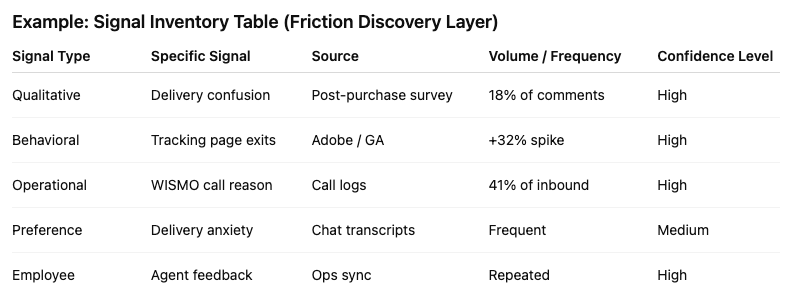
Primary Friction Summary:
Customers lack confidence in delivery timing → driving anxiety, calls, cancellations, and refunds.
Why This Table Changes Everything
Most CX dashboards show sentiment trends.
This table exposes execution targets.
Instead of:
“Customers are unhappy about delivery.”
EPS produces:
“Delivery timing uncertainty is driving call volume, cancellation, and refunds.”
That single difference turns CX from:
Emotional storytelling
into:
Operational diagnosis
Which is exactly how high-performance systems work.
Signal Coverage vs Signal Confidence
Not all signals are created equal.
EPS evaluates signals based on:
Volume
Frequency
Consistency
Cross-source validation
When:
Qualitative feedback
Behavioral data
Operational logs
Employee observations
All point to the same friction, certainty increases.
And once certainty increases, hesitation disappears.
This is what enables:
Faster prioritization
Stronger executive alignment
Higher action velocity
Because no one debates friction that is multi-source validated.
The Strategic Shift This Creates
Most CX teams debate what the problem is.
EPS teams debate how fast they can fix it.
Because the moment friction is clearly isolated:
Prioritization becomes easier
Investment decisions accelerate
Cross-functional conflict drops
Execution speed increases
This is where CX starts shaping decisions, not just informing them.
Friction → Action Mapping
The Execution Layer
Identifying friction is only half the battle.
Most organizations are already drowning in insights.
What they lack is execution velocity.
Which is why the Friction → Action Mapping layer is the most critical, and most uncomfortable, part of EPS.
Because this is where CX stops being observational and starts becoming operational.
Why Insight Without Action Is Organizational Theater
Most CX programs are incredibly good at surfacing problems.
They are far less effective at making sure those problems get solved.
So friction gets:
Logged
Categorized
Trended
Socialized
Discussed
And then quietly dies in backlog purgatory.
Not because teams don’t care.
But because no system exists to force insight into execution.
In traditional CX models:
CX identifies the problem
Operations owns process
Product owns roadmap
Marketing owns comms
IT owns platforms
Which means everyone is responsible and no one is accountable.
EPS changes that dynamic.
The Core Rule of EPS Execution
In EPS, every material friction must map to:
A specific action.
A defined owner.
A committed delivery date.
If it doesn’t, it isn’t real.
It’s just observation.
This rule creates execution pressure, which is exactly what CX has historically lacked.
The Friction → Action Mapping Table
This layer forces friction to become operational reality.
Here’s what that looks like in practice:
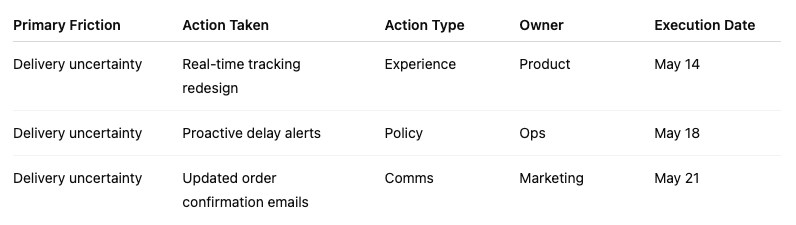
Key Insight:
If this table is empty, CX isn’t operating, it’s observing.
Why This Table Changes Power Dynamics
This table does something subtle but profound:
It gives CX operational gravity.
Instead of showing up with:
“Here are the insights we discovered…”
CX shows up with:
“Here are the actions being shipped, by whom, and by when.”
That single shift changes how CX is perceived inside the organization.
Because CX is no longer:
A messenger
A reporter
A facilitator
It becomes:
A mobilizer of execution.
Execution Velocity Is the New CX KPI
Most CX teams measure:
Survey volume
Response rates
Sentiment deltas
Case closure
EPS teams measure:
Action velocity.
How quickly can we:
Identify friction
Align stakeholders
Ship fixes
Measure behavior change
Because speed is a strategic advantage.
The faster you remove friction, the faster:
Customers convert
Support costs fall
Retention rises
Revenue compounds
This is where CX starts to behave like a growth engine, not a reporting function.
From Influence to Execution Authority
EPS doesn’t magically give CX direct control over every function.
But it does give CX execution authority.
Through:
Prioritization alignment
Cross-functional orchestration
Outcome ownership
Financial accountability
CX becomes the function that connects the dots between friction and performance.
And in modern organizations, that role carries enormous power.
Because whoever controls execution flow ultimately shapes:
Roadmaps
Investment decisions
Resource allocation
Strategic priorities
The New CX Contract
Under EPS, CX makes a bold promise to the business:
“We will not bring you problems unless we are prepared to drive solutions.”
This changes everything.
It builds trust.
It accelerates decisions.
It earns credibility.
It unlocks funding.
Because CX stops being a cost center asking for resources, and becomes a performance system generating returns.
Behavioral Impact Tracking
The Causation Engine
This is the moment where most CX ROI models collapse.
Because tracking sentiment is easy.
Tracking behavior is hard.
But only behavior proves causation.
Why Behavior Is the Only Metric That Matters
Customers don’t buy more because they feel better.
They buy more because friction was removed.
They don’t cancel less because they’re happier.
They cancel less because uncertainty, confusion, and effort were eliminated.
Behavior is the economic expression of experience.
And yet, most CX programs barely measure it.
They track:
NPS movement
CSAT deltas
Theme trends
Verbatim sentiment
Which are signals, not outcomes.
EPS replaces that logic with a single question:
What did customers do differently after we acted?
If nothing changed, nothing improved.
The EPS Causation Model
EPS uses a simple rule:
No action exists unless behavioral change can be observed.
That means every executed initiative must define:
Which customer behavior should change
How it will be measured
Over what time window
Against what baseline
This creates true causation tracking, not proxy modeling.
Behavioral Impact Tracking Table
Here’s how EPS operationalizes causation:
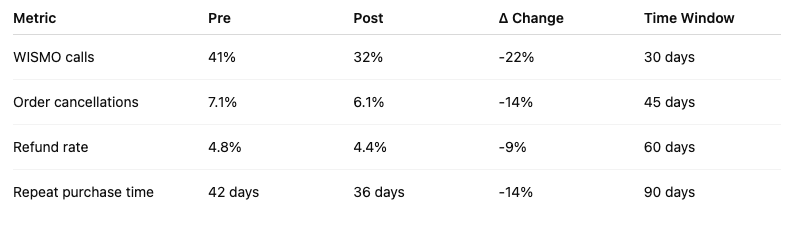
This table does something revolutionary:
It shows direct causal movement.
Not “customers feel better.”
But:
Fewer calls
Fewer cancellations
Lower refunds
Faster repurchase
That is performance.
Why This Destroys Correlation-Based ROI
Traditional CX ROI says:
“When NPS increases, revenue tends to rise.”
EPS says:
“When we removed delivery uncertainty, cancellations fell 14%, generating $980K in retained revenue.”
One is statistical probability.
The other is business reality.
This is why CFOs trust EPS.
Because finance doesn’t fund theories.
They fund validated impact.
Behavior Is Where Strategy Meets Execution
Behavioral tracking does something even more powerful:
It aligns CX directly to enterprise KPIs.
Instead of abstract experience goals, CX now owns:
Call deflection
Cost reduction
Conversion improvement
Retention acceleration
Lifetime value expansion
These are not CX metrics.
They are CEO metrics.
And when CX owns them, the function’s role fundamentally changes.
The Accountability Shift
Once behavior becomes the measurement standard, CX leaders accept a bold new contract:
“Judge us by what we change, not what we report.”
That is a terrifying shift for some.
But it is exactly what creates:
Executive trust
Strategic relevance
Budget authority
Organizational power
Because once CX can reliably produce behavioral outcomes, it becomes indispensable.
From Measurement to Motion
This is where CX stops being a monitoring system and becomes a motion engine.
Because behavior:
Moves revenue
Moves cost
Moves loyalty
Moves growth
EPS doesn’t care how pretty the dashboard is.
It cares how fast behavior changes.
Because decision velocity is the new competitive advantage.
Financial Translation
The CFO Layer
Behavior change is powerful.
But behavior alone does not earn budget.
Finance translation does.
Because no matter how compelling the experience story, executive decisions ultimately come down to:
Revenue
Cost
Risk
Growth
This is where most CX ROI models fail.
Not because they lack data.
But because they lack financial rigor.
Why CFOs Don’t Trust CX ROI Models
Most CX ROI models:
Rely on correlation
Use abstract multipliers
Depend on directional estimates
Lack operational baselines
Skip finance validation
Which means they sound plausible, but not provable.
Finance leaders don’t fund plausibility.
They fund attribution.
EPS was designed specifically to meet that standard.
The EPS Financial Translation Model
EPS converts behavioral outcomes into financial impact using three principles:
Unit economics
Volume-based scaling
Finance validation
This ensures that every CX impact claim can survive CFO-level scrutiny.
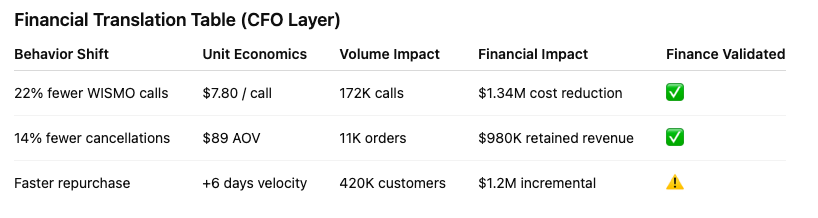
Why This Table Changes Everything
This table does what no CX dashboard ever has:
It translates experience into money.
Not hypothetical money.
Not directional value.
But validated financial outcomes.
This is the language CFOs trust.
Because this is how:
Supply chain optimization
Marketing spend
Operational efficiency
Digital investments
Are justified.
EPS simply brings CX into the same financial operating discipline.
The Shift From Advocacy to Economics
Traditional CX leaders advocate.
EPS leaders quantify.
They don’t argue:
“This will make customers happier.”
They show:
“This removed $1.34M in operating cost.”
They don’t suggest:
“This could improve loyalty.”
They demonstrate:
“This accelerated repurchase, generating $1.2M in incremental revenue.”
That single shift completely changes how CX is perceived.
Because finance does not debate math.
Why Finance Validation Is Non-Negotiable
EPS requires finance validation.
Not for politics.
For credibility.
This means:
Partnering with finance early
Agreeing on assumptions upfront
Aligning on unit economics
Validating volume calculations
Confirming attribution logic
This transforms finance from:
Skeptic
into:
Champion
Because once finance trusts your math, executive resistance disappears.
CX Enters the Investment Conversation
This is where CX finally stops defending its existence, and starts competing for capital.
Because once CX can reliably show:
Cost reduction
Revenue retention
Revenue expansion
Risk mitigation
It enters the same funding arena as:
Product innovation
Digital transformation
Marketing expansion
Operational modernization
Which is exactly where strategic CX belongs.
The Moment CX Changes Its Identity
At this stage, CX is no longer:
A listening function
A service organization
A sentiment monitor
It becomes:
A financial performance system.
And that identity shift unlocks:
Executive trust
Strategic influence
Budget authority
Organizational power
Not through persuasion.
But through proof.
EPS Performance Scorecard
Redefining CX Maturity Around Execution
For years, CX maturity has been defined by one thing:
Measurement sophistication.
More surveys.
More channels.
More dashboards.
More analytics.
More AI.
The assumption:
If we understand experience better, outcomes will follow.
But here’s the uncomfortable reality:
Most mature CX programs still struggle to drive meaningful business impact.
Which forces a hard question:
If maturity doesn’t translate into execution power, what exactly are we maturing toward?
EPS answers that question by redefining maturity around a single principle:
Execution capability.
Not insight generation.
Not reporting quality.
Not analytics depth.
Operational performance.
The EPS Maturity Model: From Measurement to Motion
EPS reframes CX maturity around five execution dimensions:
Signal Coverage
Friction Precision
Action Velocity
Behavioral Tracking
Financial Attribution
Together, these define how effectively CX converts experience into business performance.
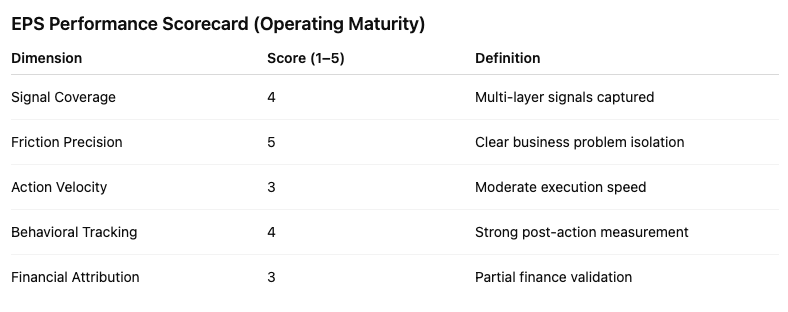
EPS Maturity Level:
➡ Execution-Driven CX
Why This Scorecard Changes the Maturity Conversation
Traditional CX maturity models reward:
Survey expansion
Channel proliferation
Dashboard sophistication
Analytical depth
EPS rewards:
Faster action
Better prioritization
Stronger causation tracking
Tighter financial linkage
This flips the maturity conversation from:
“How advanced is our CX technology stack?”
to:
“How effective is our experience execution system?”
Which is the only question executives actually care about.
What High-Maturity EPS Organizations Look Like
High-maturity EPS organizations:
Detect friction early
Prioritize based on economic impact
Ship fixes fast
Track behavioral outcomes
Translate results into financial language
They operate with:
High decision velocity
Strong execution discipline
Clear ownership
Continuous optimization loops
In these organizations, CX becomes:
A business operating system, not a measurement function.
What Low-Maturity CX Organizations Look Like
Low-maturity CX organizations often:
Drown in data
Debate priorities
Move slowly
Struggle to drive change
Fail to prove impact
Not because the teams are weak.
But because the system they operate inside was never designed for execution.
They have:
High insight
Low influence
Minimal authority
Weak business alignment
Which keeps CX trapped in:
Observation mode instead of operation mode.
The Maturity Shift That Matters
EPS forces a critical mindset change:
Maturity is not about how well you listen.
It’s about how effectively you act.
This shift changes how CX leaders:
Build teams
Choose tools
Design governance
Define success
Earn executive trust
Because maturity becomes performance capability, not analytical sophistication.
The New CX Operating Standard
EPS sets a new bar:
If your CX program cannot demonstrate action velocity, behavioral change, and financial impact, it is not mature, regardless of how advanced the dashboards look.
That standard may feel uncomfortable.
But it’s exactly what elevates CX from:
Important → Essential
Support → Strategic
Reporting → Performance
And it’s what finally gives CX leaders the operational authority they’ve always needed, but never had.
Why This Changes Executive Conversations
From Storytelling to Strategic Authority
Most CX leaders don’t struggle to get executive attention.
They struggle to hold it.
They walk into leadership meetings armed with insights, emotion, and customer stories, and walk out with polite nods, limited action, and fragile commitments.
EPS changes that dynamic entirely.
Because it changes how CX shows up.
The Old CX Executive Conversation
Traditional CX leaders walk into the room and say:
“Here’s what customers are telling us.”
They present:
NPS movement
Sentiment trends
Top drivers
Verbatim quotes
Journey pain points
Executives listen.
They care.
But then the conversation inevitably shifts to:
Revenue performance
Cost pressures
Growth strategy
Investment trade-offs
And CX quietly moves to the side of the table.
Not because experience doesn’t matter.
But because experience wasn’t translated into executive priorities.
The EPS Executive Conversation
EPS leaders walk in and say:
“Here are the three highest-impact frictions we eliminated this quarter, the actions we shipped, the behaviors that changed, and the financial impact we generated.”
Now the conversation becomes:
Performance
ROI
Growth acceleration
Cost reduction
Strategic leverage
CX is no longer presenting to executives.
CX is partnering with them.
The Power Shift
EPS fundamentally rewires CX’s role in decision-making.
Instead of:
“Here’s what customers feel.”
CX brings:
“Here’s where friction is suppressing revenue and inflating cost.”
Instead of:
“Here are some opportunities.”
CX brings:
“Here are three execution priorities with validated financial upside.”
Instead of:
“We’d like funding to improve experience.”
CX brings:
“Here’s the return profile on removing this friction.”
That is not messaging.
That is strategic positioning.
Why EPS Earns Trust, Not Just Attention
Executives don’t trust dashboards.
They trust results.
EPS builds trust through:
Action ownership
Behavioral proof
Financial validation
Which means CX stops being a voice in the room, and becomes a decision driver.
This creates:
Faster approvals
Larger budgets
Higher prioritization
Stronger executive sponsorship
Not because CX asks better.
But because CX delivers more.
CX Enters the Capital Allocation Conversation
This is the ultimate shift.
Once CX can show:
$1.3M in cost reduction
$980K in retained revenue
$1.2M in incremental growth
CX moves into the same funding category as:
Product innovation
Digital transformation
Operational modernization
Marketing expansion
Which means CX no longer competes for scraps.
It competes for capital.
And capital follows performance.
The Strategic Identity Shift
This is the moment CX stops being:
A service function
A listening engine
A reporting discipline
And becomes:
A business performance system.
Once that identity shifts, everything changes:
How CX is staffed
How CX is funded
How CX is measured
How CX is governed
How CX is positioned
This is how CX moves from:
Tactical → Strategic
Support → Essential
Reporting → Performance
The New Executive Contract
EPS establishes a new contract between CX and leadership:
“Hold us accountable for outcomes, not insights.”
That contract is terrifying.
And liberating.
Because once CX accepts performance accountability, it earns strategic authority.
This is how CX stops fighting for relevance.
And starts shaping the future of the business.
The Bigger Shift
From Customer Experience to Business Performance Engineering
What’s happening in CX right now is bigger than a methodology shift.
Bigger than new tools.
Bigger than AI.
Bigger than dashboards.
Bigger than maturity models.
It is a category-level transformation.
CX is moving from:
Understanding experience
to:
Engineering business performance.
This is the moment every operational discipline eventually reaches.
Marketing moved from awareness → revenue operations.
IT moved from infrastructure → digital transformation.
Analytics moved from reporting → business intelligence.
Now CX is undergoing the same evolution.
And the implications are massive.
The End of Experience Management
Traditional experience management was built to:
Collect feedback
Track sentiment
Monitor journeys
Surface insights
It helped organizations understand customers better.
But understanding does not guarantee performance.
In modern markets defined by:
Speed
Competition
Fragmentation
Rising customer expectations
Understanding is no longer enough.
Execution is the advantage.
Which means CX must evolve from:
Experience management → Experience performance engineering
This is not semantic.
It is structural.
What Business Performance Engineering Really Means
Business performance engineering means designing systems that:
Detect friction early
Prioritize based on economic impact
Mobilize execution rapidly
Track behavioral causation
Translate outcomes into financial results
This requires:
New operating models
New governance structures
New leadership capabilities
New metrics
New internal power dynamics
This is what EPS provides.
Not a better CX framework.
A new business system.
Why This Shift Is Inevitable
Three forces are driving this transformation:
1. Executive Impatience
Executives no longer tolerate:
Slow insights
Vague impact
Directional ROI
Endless analysis
They demand:
Action
Speed
Results
Financial proof
EPS meets that demand.
Traditional CX cannot.
2. Economic Pressure
As growth slows and costs rise, every function must:
Prove impact
Defend budget
Generate return
Sentiment alone cannot survive inside that environment.
Performance can.
3. Decision Velocity as Competitive Advantage
In modern business, speed of execution is the moat.
The organizations that win are those that:
Identify friction faster
Act sooner
Adapt quicker
Learn continuously
EPS is built to maximize decision velocity.
Which makes it a competitive system, not a CX one.
The New Identity of CX Leaders
This shift completely redefines the role of the CX leader.
They are no longer:
Experience managers
Survey experts
Dashboard owners
Insight reporters
They become:
Business performance engineers.
Operators who:
Diagnose friction
Mobilize execution
Engineer behavioral change
Deliver financial outcomes
This is a new leadership archetype.
And it is exactly what modern organizations need.
The Industry Reckoning Ahead
This shift will not be comfortable.
Because it forces the CX industry to confront a hard truth:
Most CX programs were never designed to produce business outcomes.
They were designed to measure sentiment.
Which means:
Some roles will disappear
Some skills will become obsolete
Some vendors will lose relevance
Some leaders will struggle to adapt
But the organizations that make this transition will unlock:
Faster growth
Lower cost structures
Higher customer loyalty
Stronger competitive advantage
This is the inflection point.
EPS as the New Operating Standard
EPS does not compete with traditional CX.
It replaces it.
Not by eliminating experience measurement, but by subordinating it to performance execution.
This is the difference between:
Observing the system
and
Operating the system.
And once CX becomes operational, it becomes strategic.
Once it becomes strategic, it becomes essential.
Once it becomes essential, it becomes indispensable.
Call to Action
Operate Or Be Operated On
This is the moment of truth for CX.
Not philosophically.
Operationally.
Because once you understand the gap between insight and impact, you can’t unsee it.
You can either:
Continue optimizing dashboards
Refine sentiment models
Build prettier reports
Tell better stories
Or you can:
Build a system that actually moves the business.
For CX Practitioners
If you lead, build, or influence CX, here’s your challenge:
Stop operating like a reporting function.
Start operating like a performance leader.
Download the CX Operator Worksheet.
Not to admire it.
Not to customize it.
Not to socialize it.
But to use it.
Map your signals.
Isolate friction.
Force execution.
Track behavior.
Translate outcomes.
Operate.
Because CX leaders who cannot demonstrate action, causation, and financial impact will always struggle for influence, no matter how good their dashboards look.
For Executives
Here’s the question every leadership team should ask:
Can our CX organization clearly show how customer friction becomes financial performance?
If the answer is no, you are not funding experience.
You are funding observation.
Which means:
Friction persists
Costs rise
Growth slows
Loyalty erodes
Because no one owns execution.
If you want CX to become a growth engine, not a reporting function, it requires a new operating model.
One built for:
Decision velocity
Execution discipline
Behavioral causation
Financial accountability
That system is EPS.
The Real Choice Facing CX
CX stands at a crossroads.
One path leads to:
Better analytics
Smarter dashboards
More sophisticated reporting
Continued fights for funding
The other leads to:
Execution authority
Strategic influence
Financial credibility
Organizational power
Both paths require effort.
Only one delivers impact.
Final Thought
The future of CX will not be shaped by who listens best.
It will be shaped by who acts fastest.
Who executes smartest.
Who proves impact most clearly.
Because in the end, experience does not win on sentiment.
It wins on performance.