

THE NEXT EVOLUTION
Most Professionals Spend Their Careers Trying To Be Persuasive. Elite Operators Learn The Laws That Move Organizations.
The 24 Laws of Experience Performance reveals the hidden forces that determine why some ideas gain momentum, some initiatives get funded, and some leaders become indispensable.
Built from years of coaching leaders implementing Experience Performance inside complex organizations.
THE PATTERN
Organizations Don't Move Because
They Understand Something.
They Move Because
They Decide Something.
And Decisions Follow Laws.
Every organization has an invisible operating system.
A set of unwritten rules that determine:
- Which ideas get funded
- Which priorities gain momentum
- Which leaders gain influence
- Which initiatives stall
- Which transformations succeed
Most professionals never learn those rules.
This book exists to make them visible.
THE DISCOVERY
I Thought The Challenge
Was Teaching The System.
I Was Wrong.
The Challenge Was Implementing It.
After publishing The Experience Performance System™, I spent years coaching leaders across retail, banking, healthcare, technology, telecommunications, travel, and manufacturing.
The same barriers kept appearing.
Different companies.
Different executives.
Different industries.
The same patterns.
Eventually I realized these weren't isolated problems.
They were laws.
Twenty-four recurring forces that determined whether Experience Performance became operational or remained a presentation.
This book is the result.
THE MOMENT EVERYTHING CHANGED
Meeting One.
Great Insights.
Nothing Happened.
Meeting One
I presented dashboards.
Leadership nodded.
The meeting moved on.
Meeting Two
Great Business Cases.
Still No Movement.
I fixed the format.
I hadn't fixed the process.
Meeting Three
Stakeholders Presented The Cases Themselves.
Priorities shifted.
Resources moved.
Momentum began.
That was the moment I realized:
Organizations Don't Move Because
They Understand Something.
They Move Because
They Decide Something.
THE LAWS
Most People See Activities. Operators See Patterns. The 24 Laws That Govern Organizational Movement.
These laws were not created in a workshop.
They emerged from years of coaching leaders implementing Experience Performance inside complex organizations.
Different industries. Different executives. Different challenges. The same patterns. The same outcomes. The same laws.
LAW #1
Executives Fund Outcomes, Not Ideas
Investment follows consequences, not concepts.
LAW #2
Control The Frame
The problem definition shapes the decision.
LAW #3
Decisions Are Emotional
Logic informs. Emotion authorizes.
LAW #4
Alignment Beats Authority
Consensus creates more movement than hierarchy.
LAW #5
Know Who Actually Decides
Titles suggest power. Decision systems reveal it.
LAW #6
Shipping Beats Pitching
Execution creates momentum faster than persuasion.
LAW #7
Results Silence Critics
Performance is influence made visible.
LAW #8
Priority Is Prior
Everything cannot be important at once.
LAW #9
Friction Reveals Truth
Effort exposes problems before metrics do.
LAW #10
Problem Selection Determines Influence
The problems you choose determine your impact.
LAW #11
Speed Is A Strategic Weapon
Learning velocity beats perfect planning.
LAW #12
Constraints Create Clarity
Limits force better decisions.
LAW #13
Trade-Offs Signal Leadership
Every priority reveals a sacrifice.
LAW #14
Momentum Is A Force Multiplier
Movement creates more movement.
LAW #15
Visibility Drives Priority
Organizations act on what they can clearly see.
LAW #16
Language Shapes Reality
Words influence how problems are solved.
LAW #17
Resistance Reveals Reality
Resistance exposes what the system values.
LAW #18
Resistance Points To Value
Pushback often signals opportunity.
LAW #19
Positioning Determines Power
How an idea enters the system shapes its future.
LAW #20
Don't Win Arguments, Win Outcomes
Being right is useless if nothing changes.
LAW #21
Clarity Removes Politics
Confusion creates friction. Clarity creates movement.
LAW #22
Consistency Builds Authority
Trust compounds through repetition.
LAW #23
Ownership Creates Gravity
People commit to what they help create.
LAW #24
The System Always Wins
Performance follows systems, not heroics.
THE QUESTION
Most Professionals Learn These Laws After Years Of Trial And Error. You Don't Have To.
The 24 Laws of Experience Performance distills years of executive coaching, organizational transformation, and real-world implementation into a practical guide for people responsible for creating change.
GET LAW #1 FREE
Executives Fund Outcomes, Not Ideas.
Get Law #1 from The 24 Laws of Experience Performance and discover why great ideas get compliments while consequences get budget.
Learn the first law that determines which initiatives get funded, which priorities gain momentum, and why some leaders consistently move organizations while others struggle to gain traction.
THE ARCHITECTURE
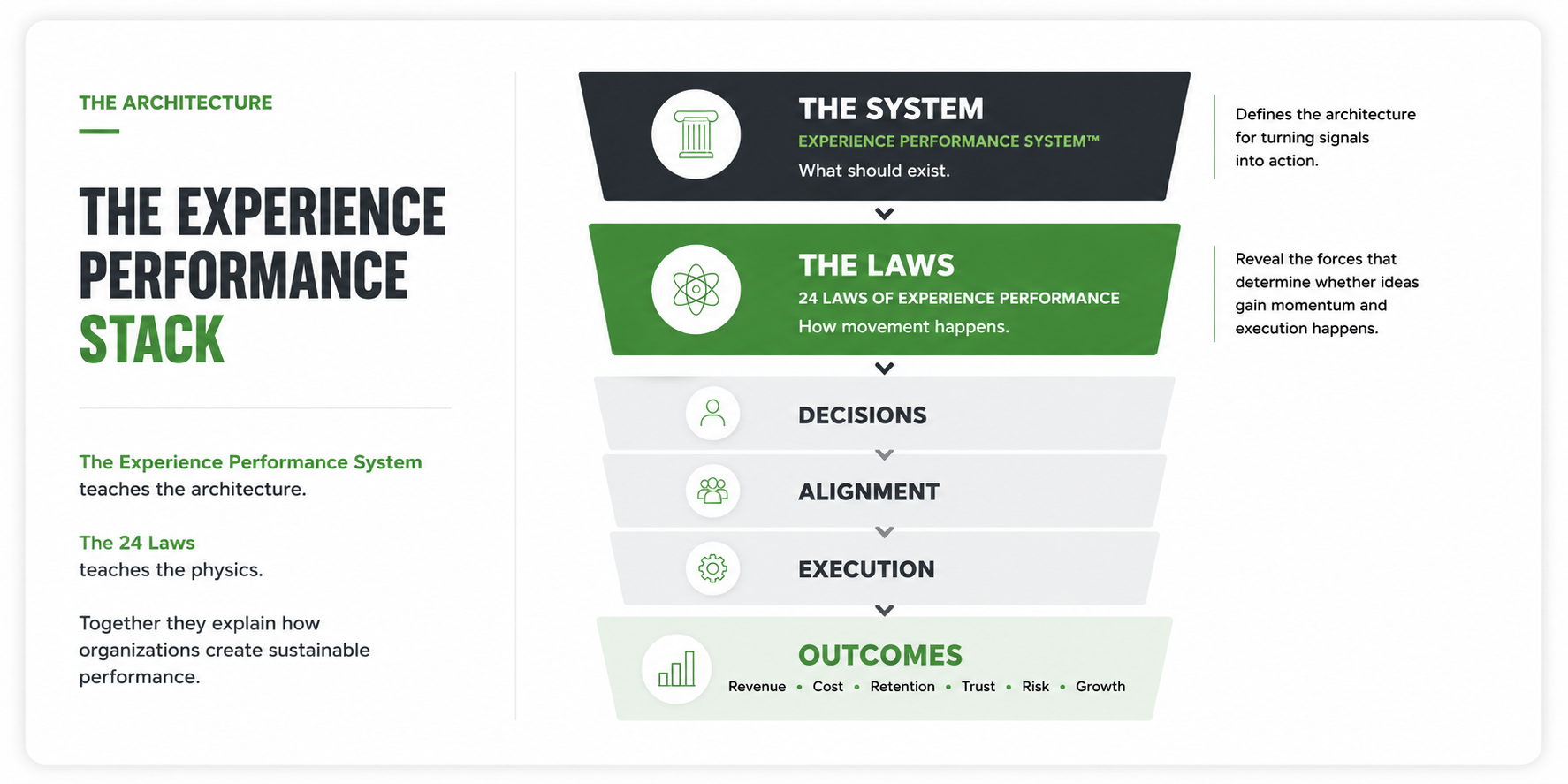
The System Explains What To Build. The Laws Explain How Organizations Move.
Most organizations understand what needs to improve.
Far fewer understand how ideas gain momentum, how priorities shift, and how execution actually happens.
The Experience Performance System™ provides the architecture for turning signals into action.
The 24 Laws reveal the forces that determine whether ideas gain traction, alignment forms, and change becomes operational.
Together they explain how organizations create sustainable performance.
BUILT FOR OPERATORS
This Is Not A CX Book. It's A Book About How Organizations Actually Work.
Anyone responsible for turning ideas into action.
THE INVITATION
Most Professionals React. A Small Number Learn How To Shape Organizations.
Join the early access list and be among the first to read The 24 Laws of Experience Performance.
Learn the principles that determine why some ideas gain momentum, some initiatives get funded, and some leaders consistently create movement inside complex organizations.
Because organizations don't move because they understand something.
They move because they decide something.