

Experience isn’t managed. It’s performed.
The Experience Performance System™ is the operating system for identifying friction, prioritizing action, and improving business performance across customers, employees, and operations.
Most CX programs were built to measure. EPS was built to improve performance.
Most CX frameworks help organizations understand customers. EPS helps organizations improve performance by connecting signals, friction, decisions, execution, and outcomes.
Why Customer Experience Stalls.
Most organizations are not short on customer insight. They are short on the operating system required to convert insight into prioritized action, execution, and measurable performance improvement.
Data Rich.
Action Poor.
Organizations collect millions of signals yet struggle to turn them into action.
Governance Heavy.
Execution Light.
Committees move slower than customers.
Score Focused.
Outcome Blind.
Experience metrics improve while operational friction remains.
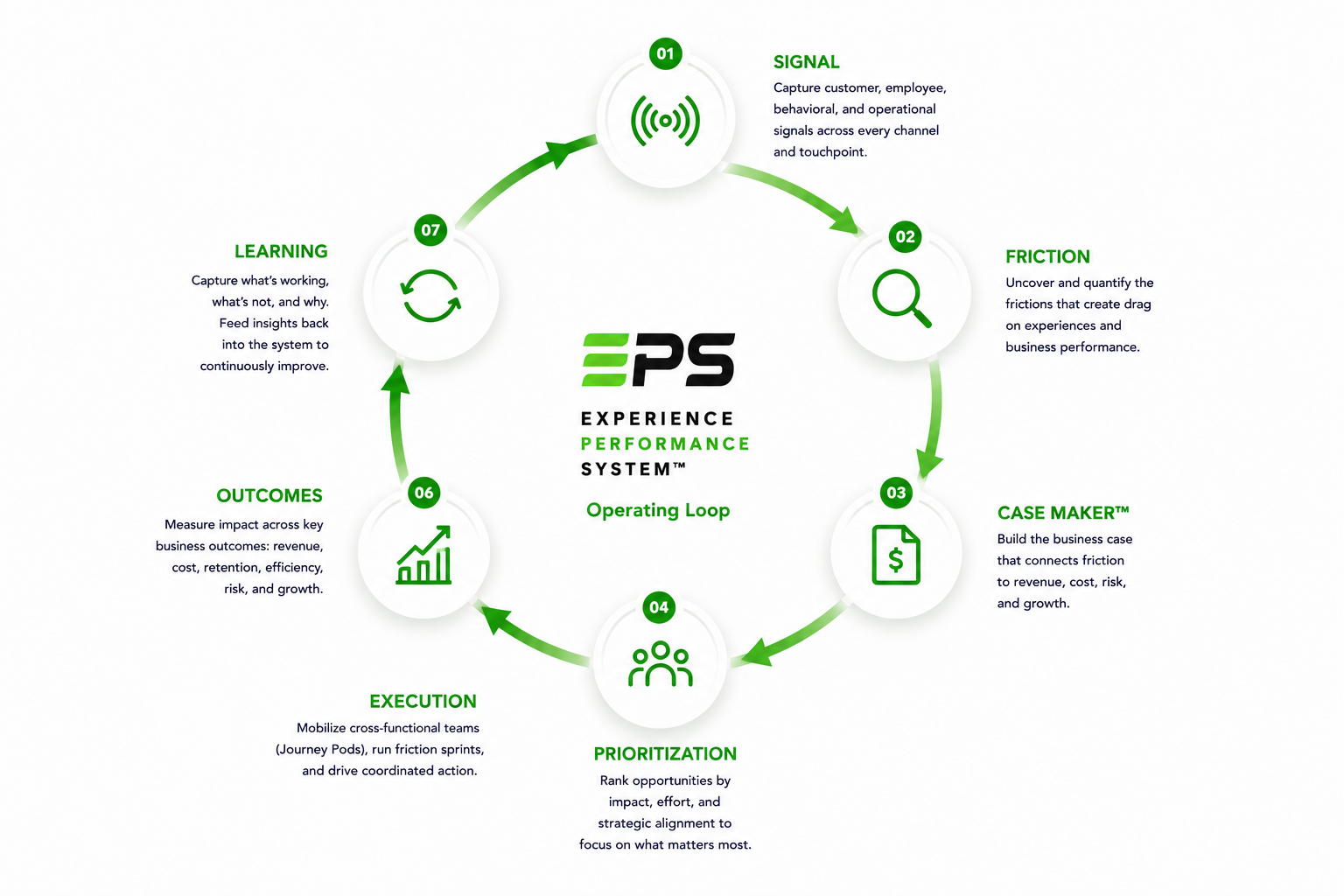
EPS turns experience into an operating rhythm.
The system connects signals, friction, prioritization, execution, and learning so organizations can move from insight to measurable performance improvement.
Capture Signals
Unify customer, employee, behavioral, and operational signals across the business.
Quantify Friction
Connect experience issues to revenue, cost, retention, risk, and growth.
Prioritize Action
Focus resources on the frictions where performance gains are largest.
Drive Execution
Mobilize journey pods, friction sprints, champions, and cross-functional ownership.
Continuously Learn
Create feedback loops that improve decisions, strengthen execution, and evolve the system over time.
The System Compounds.
Traditional CX operates in projects.
EPS operates in loops.
Every action creates new intelligence.
Every sprint improves the system.
Every improvement accelerates performance.
The Building Blocks Of Experience Performance.
The models are not standalone frameworks. They are operating components that work together to help organizations detect friction, prioritize action, mobilize execution, and improve performance.
Signal Model
Integrates customer, employee, behavioral, operational, and preference signals.
Learn More →Friction Model
Identifies, categorizes, and quantifies the frictions creating business drag.
Learn More →Employee Signal Model
Turns frontline and workforce insight into operational intelligence.
Learn More →Case Maker™ Model
Builds the business case that connects friction to revenue, cost, risk, and growth.
Learn More →Prioritization Model
Ranks opportunities by impact, urgency, effort, and strategic alignment.
Learn More →Influence Model
Maps power, incentives, and alignment needed to move work through the business.
Learn More →Champion Model
Activates internal champions who influence, mobilize, and drive change.
Learn More →Close Plan Model
Creates clear execution milestones, owners, risks, blockers, and next actions.
Learn More →Momentum Plan Model
Sustains progress through early wins, confidence building, and performance proof.
Learn More →Pod Model
Organizes cross-functional teams around journey friction and measurable outcomes.
Learn More →Built to diagnose. Designed to execute.
EPS includes practical tools operators can use to identify friction, build the business case, align teams, and activate measurable change.
Signal Assessment
Evaluate how well your organization captures customer, employee, behavioral, and operational signals.
Explore Tool →Friction Mapping Canvas
Identify where friction occurs, who it impacts, and how it connects to business performance.
Explore Tool →CX Case Maker™
Translate customer friction into a one-page business case executives can understand, prioritize, and fund.
Explore Tool →Journey Pod Charter
Define ownership, roles, sprint priorities, outcomes, and operating rhythm for cross-functional execution.
Explore Tool →Prioritization Sprint
Rank opportunities by impact, effort, urgency, and strategic alignment to focus on what matters most.
Explore Tool →Executive Friction Review
Turn recurring friction into executive-ready decisions tied to revenue, cost, risk, retention, and growth.
Explore Tool →You don’t need another dashboard. You need a new operating identity.
EPS changes the role of experience leadership from reporting customer feedback to operating the system that improves how the business performs.
Reports what customers said.
Owns dashboards, surveys, and readouts.
Escalates issues through governance.
Measures score movement.
Waits for cross-functional action.
Translates signals into business decisions.
Identifies friction and quantifies performance drag.
Builds cases executives can prioritize and fund.
Mobilizes journey pods and sprint-based execution.
Improves revenue, cost, retention, risk, and decision velocity.
The Future Isn’t Human + AI.
The next era of experience performance will be shaped by three workforces operating together: humans managing outcomes, agents executing decisions, and systems orchestrating performance.
Human Workforce
Judgment, creativity, relationships, strategy, ethics, and outcome ownership.
Agent Workforce
Analysis, monitoring, coaching, decision execution, and resolution support.
System Workforce
Workflows, routing logic, knowledge systems, escalation paths, and automation layers.
Agentic CX does not begin with more automation. It begins with a clearer operating system for signals, friction, decisions, ownership, and performance.
Learn About Agentic CX →Ready to move from management to performance?
Start with the system. Explore the models, download the overview, access the worksheets, or work directly with Experience Performance Group to build your operating rhythm.
Download EPS Overview
Get the concise blueprint for how the Experience Performance System™ works.
Download →Explore The Models
See the 13 operating components that power experience performance.
Explore →Access The Worksheets
Use practical tools to map friction, prioritize action, and build business cases.
Access →Work With Experience Performance Group
Partner with EPG to design, activate, and scale your experience performance system.
Work With Us →